
The connection between emotional wounds and physical disease isn’t mystical—it’s increasingly supported by scientific research in fields like psychoneuroimmunology, which studies how psychological factors affect the immune system. Explained by Disease and Emotion Healer in Mumbai – Dr Sharmila
Nisha had seen five doctors in two years. Each ran tests, each found nothing conclusive, yet the pain persisted. At 42, she suffered from chronic migraines, digestive issues that appeared suddenly three years ago, and recently, an autoimmune condition that left her exhausted and inflamed.
“We can manage the symptoms,” her rheumatologist said, prescribing another medication. “But we don’t really know what causes autoimmune disorders.”
Nisha left the appointment frustrated and frightened. The medications helped somewhat, but she felt she was chasing symptoms without addressing the real problem. Her body was attacking itself, and no one could tell her why.
It wasn’t until a friend suggested meeting with Dr. Sharmila that a different possibility emerged—one that Western medicine rarely explores. What if her physical ailments weren’t random? What if her body was expressing what her words could not?
During their first session, Dr. Sharmila asked an unexpected question: “Tell me about your emotional life. What happened three years ago when your symptoms began?”
Nisha paused, uncomfortable. “Nothing. Well, my mother passed away, but that’s not related to my stomach issues.”
“Tell me about your relationship with your mother,” Dr Sharmila prompted gently.
And with that question, years of suppressed emotion began surfacing—along with the realisation that her body had been speaking what she’d refused to acknowledge.
The connection between emotional wounds and physical disease isn’t mystical—it’s increasingly supported by scientific research in fields like psychoneuroimmunology, which studies how psychological factors affect the immune system.
The Science Behind Emotional-Physical Connection
Stress Response System – When we experience emotional distress, our body activates the stress response. The hypothalamic-pituitary-adrenal (HPA) axis releases cortisol and other stress hormones. Short-term, this is protective. Long-term, chronic emotional stress creates physiological changes that manifest as disease.
Immune System Dysregulation – Chronic emotional stress suppresses immune function, making us more susceptible to infections, autoimmune conditions, and inflammatory diseases. Suppressed emotions create internal stress that the immune system responds to as if fighting an invisible enemy—sometimes attacking the body’s own tissues.
Inflammation – Emotional wounds create chronic low-level inflammation in the body. This inflammation underlies many chronic diseases: heart disease, diabetes, autoimmune conditions, digestive disorders, and even cancer.
Nervous System Dysregulation – Unprocessed trauma and emotional wounds keep the nervous system in a state of hyperarousal or shutdown. This affects every bodily system, from digestion to cardiovascular function to hormonal balance.
Cellular Memory – Emerging research suggests that cells hold memory of trauma and emotional experiences. This cellular memory can influence gene expression and physical health across a lifetime.
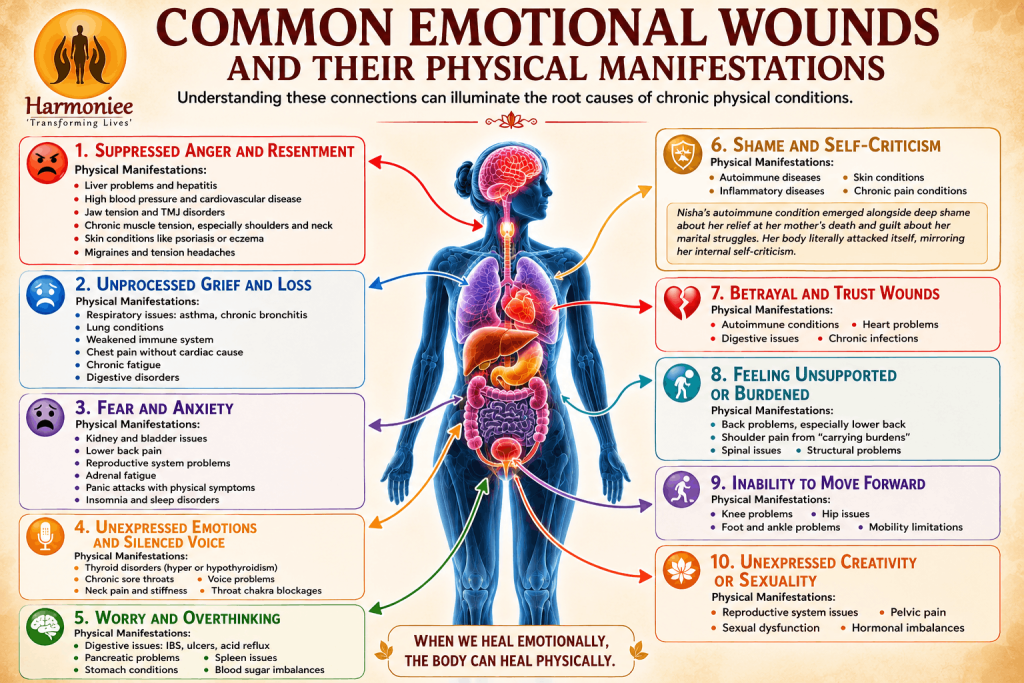
Ancient healing traditions from Ayurveda to Traditional Chinese Medicine have long recognized the connection between emotions and physical health. Each emotion was believed to affect specific organs:
While Western medicine initially dismissed these connections, modern research increasingly validates these ancient observations through different language and frameworks.
As Nisha began exploring her emotional landscape in therapy, a pattern emerged. Her digestive issues had started shortly after her mother’s death—but the relationship had been complicated.
Nisha’s mother had been critical and controlling throughout Nisha’s life. Nothing was ever good enough. Nisha’s career choices, her marriage, even her parenting were subjects of constant judgment. Yet Nisha had never expressed her hurt or anger, believing it was disrespectful to challenge her mother.
When her mother died suddenly, Nisha felt not only grief but also relief—and profound guilt about that relief. She couldn’t acknowledge these conflicting feelings, so she swallowed them, literally and figuratively.
“I can’t digest this,” she told Dr. Sharmila one session, referring to her mother’s death and their unresolved relationship. The metaphor was literal—her digestive system had stopped functioning properly.
The migraines had begun even earlier, during a period of intense workplace stress where Nisha felt constantly pressured to perform but unable to voice her overwhelm. “I felt like my head would explode,” she recalled. It did—through chronic migraines.
The autoimmune condition appeared when Nisha’s marriage began struggling. Her husband was having an emotional affair, and Nisha felt betrayed but couldn’t confront him. Her immune system, meant to protect her, began attacking her own body—a physical manifestation of the internal betrayal she couldn’t address.
Understanding these connections can illuminate the root causes of chronic physical conditions.
Suppressed Anger and Resentment
Physical Manifestations:
Nisha’s migraines intensified during periods when she suppressed frustration at work or home. Her body expressed the anger she wouldn’t allow herself to feel.
Unprocessed Grief and Loss
Physical Manifestations:
After her mother’s death, Nisha’s lungs—metaphorically the organs that hold grief—became vulnerable. She developed recurring respiratory infections she’d never experienced before.
Fear and Anxiety
Physical Manifestations:
Unexpressed Emotions and Silenced Voice
Physical Manifestations:
Worry and Overthinking
Physical Manifestations:
Nisha’s digestive system bore the brunt of both her unprocessed grief and her chronic worry about pleasing others and avoiding conflict.
Shame and Self-Criticism
Physical Manifestations:
Nisha’s autoimmune condition emerged alongside deep shame about her relief at her mother’s death and guilt about her marital struggles. Her body literally attacked itself, mirroring her internal self-criticism.
Betrayal and Trust Wounds
Physical Manifestations:
Feeling Unsupported or Burdened
Physical Manifestations:
Inability to Move Forward
Physical Manifestations:
Unexpressed Creativity or Sexuality
Physical Manifestations:

Nisha’s healing required addressing both her physical symptoms and their emotional roots.
Family Constellation Therapy
Family Constellation work revealed generational patterns in Nisha’s family. Her mother had also suffered from digestive issues and had an unresolved, difficult relationship with her own mother. This pattern of swallowed emotions and unspoken resentment had been passed through generations.
The constellation showed Nisha unconsciously loyal to her mother’s pattern of suffering in silence. By acknowledging this pattern and consciously choosing differently, Nisha could break the cycle.
In a powerful moment during constellation work, Nisha spoke to a representative of her mother: “I love you, and I honour you. But I release your pain. It’s not mine to carry in my body anymore.”
Emotional Expression and Release
Dr. Sharmila created safe spaces for Nisha to express what had been suppressed:
Anger Work – Nisha was encouraged to express her anger about her mother’s criticism, her husband’s betrayal, her workplace pressures. Through techniques like hitting pillows, vocal expression, and letter writing (not sent), she released decades of suppressed rage.
Initially uncomfortable with anger, Nisha gradually learned it wasn’t destructive—suppressing it was. Expressing it safely actually reduced her migraines significantly.
Grief Processing – Nisha needed to grieve not just her mother’s death but also the mother-daughter relationship she’d never had. She grieved the childhood where she felt constantly criticized, the adulthood where she couldn’t be herself around her mother.
Through this grief work, her respiratory issues began improving. Her lungs could finally release what they’d been holding.
Voice Activation – Nisha practiced speaking her truth in therapy—expressing needs, stating boundaries, voicing disagreements. As she developed her voice emotionally, her chronic sore throats decreased.
Somatic Therapy and Body Work
Emotions are stored in the body. Somatic approaches helped release what was held physically.
Body Scanning – Nisha learned to notice where she held emotion physically. Anger in her jaw and shoulders. Grief in her chest. Fear in her lower back and belly.
Breathwork – Specific breathing techniques helped release stored emotions and trauma from the body. During breathwork sessions, Nisha sometimes experienced spontaneous emotional releases—crying, shaking, or expressions of anger she hadn’t consciously accessed.
Movement and Dance – Gentle movement practices allowed emotions to move through and out of the body rather than remaining stuck.
Massage and Bodywork – Therapeutic touch helped release muscular holding patterns created by years of emotional suppression.
Inner Child Healing
Much of Nisha’s pattern of suppressing emotions began in childhood. Inner child work involved connecting with younger parts of herself who had learned that expressing feelings was unsafe.
She visualized holding her child self, telling her: “Your feelings matter. It’s safe to feel angry when someone hurts you. It’s okay to say no. You don’t have to be perfect to be loved.”
This reparenting work changed her relationship with her emotions, making it safer to feel and express them in the present.
Cognitive Restructuring
Nisha had beliefs that reinforced emotional suppression: “Good daughters don’t get angry at their mothers,” “I should be grateful, not resentful,” “Expressing negative emotions is selfish.”
Through cognitive work, she examined and challenged these beliefs, replacing them with healthier ones: “All emotions are valid information,” “I can love someone and still feel hurt by their actions,” “Expressing emotions is healthy and necessary.”
Dr. Sharmila also recommended complementary approaches:
Anti-Inflammatory Diet – Reducing inflammation through nutrition supported her body’s healing alongside emotional work.
Meditation and Mindfulness – Regular practice helped Nisha stay present with emotions rather than suppressing them, and reduced stress-related inflammation.
Yoga – Combined physical movement with breathwork and emotional awareness, supporting integrated healing.
Journaling – Daily emotional expression through writing provided an outlet for feelings and helped track the emotion-symptom connection.
Energy Healing – Modalities like Reiki helped clear energetic blockages related to suppressed emotions.
Relationship Healing
Nisha’s physical healing required addressing her relationship wounds.
Marriage Counseling – She and her husband entered therapy to address the betrayal and rebuild trust. As they worked through their issues and Nisha learned to express her hurt and needs, her autoimmune symptoms began improving.
Boundary Setting – Nisha practiced setting boundaries with family members, colleagues, and friends. Learning to say “no” and express preferences reduced her chronic stress and physical symptoms.
Authentic Communication – As she became more authentic in relationships—expressing both positive and negative feelings—her overall health improved.
The Transformation
Healing wasn’t instant, but it was profound. Within six months of beginning therapy and making lifestyle changes, Nisha noticed significant improvements:
Her doctors were surprised by the improvements, attributing them to the medications. Nisha knew differently—the medications had remained constant, but her emotional work had changed everything.
Most significantly, Nisha developed a new relationship with her body. Instead of viewing it as broken or attacking her, she understood it had been trying to communicate what she wouldn’t acknowledge. Her symptoms were messengers, not enemies.
“My body was never the problem,” she reflected. “It was trying to protect me by forcing me to address what I was avoiding. Once I listened and did the emotional work, my body could finally heal.”
Understanding the emotional-physical connection can illuminate your own health challenges:
Track Symptom Onset – When did physical symptoms begin? What was happening emotionally in your life at that time?
Notice Pattern Connections – Do symptoms worsen during emotional stress? Do they improve when you express feelings or resolve conflicts?
Listen to Metaphors – The language we use about illness often reveals emotional connections: “I can’t stomach this situation,” “This is a pain in the neck,” “It breaks my heart.”
Explore Family Patterns – Do family members have similar conditions? What emotional patterns run in your family?
Ask Your Body – In meditation, ask affected areas: “What are you trying to tell me? What emotion are you holding?”
The Integrated Approach to Healing
Healing the emotional-physical connection requires addressing both aspects:
Medical Care – Continue appropriate medical treatment for symptoms while addressing root causes.
Emotional Healing – Work with therapists trained in trauma, somatic therapy, or Family Constellation to process emotional wounds.
Body-Based Practices – Engage in yoga, breathwork, dance, or other somatic practices that help release stored emotions.
Lifestyle Changes – Support physical healing through nutrition, sleep, movement, and stress reduction.
Relationship Work – Address relationship wounds and communication patterns that create ongoing emotional stress.
Spiritual Practices – Many find that meditation, prayer, or other spiritual practices support holistic healing.
Nisha Today
Three years into her healing journey, Nisha’s health has transformed. Her autoimmune condition is in remission. Migraines are rare. Her digestion is normal. Bloodwork shows reduced inflammation markers.
But the deeper transformation is emotional. Nisha has learned to honor her feelings, express her needs, and set boundaries. She’s developed authentic relationships based on honesty rather than people-pleasing.
She’s also developed compassion for her mother, understanding that her mother’s criticism came from her own unhealed wounds. This doesn’t excuse the harm, but it frees Nisha from carrying resentment in her body.
Recently, when facing a stressful work situation, Nisha felt familiar tension in her stomach. But this time, she paused and asked, “What am I feeling that I’m not expressing?” She identified frustration and anxiety, then addressed the situation directly with her supervisor.
The stomach tension dissolved. Her body no longer needed to speak for her—she was using her voice.
Our bodies are not separate from our emotions—they’re intimately connected. Physical disease often has emotional roots that conventional medicine doesn’t address. This doesn’t mean illness is “all in your head” or that you can simply think yourself well. It means that true healing often requires addressing both physical symptoms and emotional wounds.
Your body is always communicating. Pain, illness, and disease are sometimes messages about unprocessed emotions, unresolved trauma, or suppressed feelings that need acknowledgment and expression.
Listening to these messages and doing the emotional work alongside medical treatment can create profound healing—not just of symptoms, but of the whole person.
If you’re struggling with chronic physical conditions that don’t fully respond to medical treatment, consider exploring the emotional dimension. The healing you seek may require not just treating your body, but also tending to your heart.
Visit harmoniee.in and connect with Dr. Sharmila. Through Family Constellation Therapy, Somatic Healing, Inner Child Work, and integrated approaches, discover the emotional-physical connections affecting your health. True healing addresses both body and soul. Your journey to wholeness begins now.
Dr. Sharmila employs a compassionate and holistic approach in her therapy sessions. She focuses on understanding the root causes of issues and utilizes various therapeutic techniques to help clients release physical and emotional ailments. As a Toxic relationship therapist in Mumbai, she aims to empower individuals to embrace their bodies and cultivate self-acceptance.